
Best AI Tools for Digital Marketing in 2026: The Ultimate Guide
Artificial Intelligence (AI) has transformed the way businesses market their products and services. From creating high-quality content to automating customer support and optimizing ad campaigns, AI helps marketers save time, improve performance, and make better decisions.
If you’re looking for the best AI tools for digital marketing, this guide covers the top platforms, their benefits, and how to choose the right one for your business.
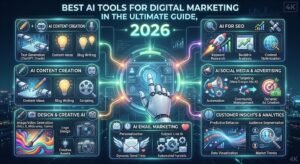
Why AI Is Essential for Digital Marketing in 2026
AI enables marketers to automate repetitive tasks, personalize customer experiences, analyze large amounts of data, and improve campaign performance.
Some of the biggest benefits include:
- Faster content creation
- Better SEO optimization
- Improved customer engagement
- Smarter email marketing
- Higher advertising ROI
- Enhanced social media management
- Data-driven marketing decisions
Businesses that use AI effectively can improve productivity while delivering more relevant experiences to their audience.
15 Best AI Tools for Digital Marketing
1. ChatGPT
Best For: Content writing, brainstorming, SEO content, email marketing, customer support, and marketing strategy.
Key Features:
- Blog writing
- Social media captions
- Email campaigns
- Keyword ideas
- Product descriptions
- Ad copy generation
2. Jasper AI
Best For: Marketing copy and long-form content.
Key Features:
- Blog writing
- Landing pages
- Brand voice
- Marketing campaigns
3. Surfer SEO
Best For: SEO content optimization.
Key Features:
- Content scoring
- Keyword recommendations
- SERP analysis
- On-page SEO optimization
4. Semrush AI Features
Best For: SEO, keyword research, competitor analysis, and content planning.
Key Features:
- Keyword tracking
- Site audits
- AI content assistance
- Competitor insights
5. Canva AI
Best For: Graphic design and marketing creatives.
Key Features:
- AI image generation
- Social media graphics
- Presentations
- Video editing
6. Grammarly
Best For: Writing improvement and professional communication.
Key Features:
- Grammar checking
- Tone suggestions
- Clarity improvements
- Email optimization
7. Copy.ai
Best For: Marketing copy and product descriptions.
Key Features:
- Ad copy
- Sales emails
- Landing page content
- Blog outlines
8. HubSpot AI
Best For: CRM and marketing automation.
Key Features:
- Email marketing
- Lead nurturing
- AI-powered CRM
- Customer segmentation
9. Mailchimp AI
Best For: Email marketing automation.
Key Features:
- Email generation
- Audience segmentation
- Campaign optimization
- Performance analytics
10. Buffer AI
Best For: Social media management.
Key Features:
- Caption generation
- Content scheduling
- Performance tracking
11. Midjourney
Best For: Creative visuals and advertising images.
Key Features:
- AI artwork
- Product images
- Social media graphics
- Brand concepts
12. Google Gemini
Best For: Research, brainstorming, and productivity.
Key Features:
- Content ideas
- Research assistance
- Data summaries
13. Claude
Best For: Long-form writing and document analysis.
Key Features:
- Reports
- Content editing
- Marketing strategies
- Business documentation
14. Notion AI
Best For: Marketing project management.
Key Features:
- Meeting notes
- Content calendars
- Brainstorming
- Documentation
15. Zapier AI
Best For: Workflow automation.
Key Features:
- Marketing automation
- Lead management
- CRM integrations
- Task automation
How to Choose the Best AI Tool for Digital Marketing
Consider these factors before selecting an AI tool:
- Your marketing goals
- Budget
- Ease of use
- Integration with existing tools
- Collaboration features
- Customer support
- Scalability
- Data security
Choosing tools that fit your workflow is often more valuable than using the largest number of platforms.
Benefits of Using AI in Digital Marketing
AI helps businesses:
- Save time
- Reduce marketing costs
- Improve SEO
- Generate quality content
- Increase conversion rates
- Personalize customer experiences
- Analyze campaign performance
- Improve decision-making
When combined with human creativity and strategy, AI can significantly increase marketing efficiency.
Frequently Asked Questions (FAQs)
1. What are the best AI tools for digital marketing?
Some of the best AI tools for digital marketing include ChatGPT, Jasper AI, Surfer SEO, Semrush, Canva AI, HubSpot AI, Mailchimp AI, Buffer AI, Claude, Notion AI, and Zapier AI. The best choice depends on your goals, budget, and marketing needs.
2. Which AI tool is best for SEO?
Surfer SEO and Semrush are excellent for keyword research, content optimization, technical SEO, and competitor analysis. Many marketers also use ChatGPT to help create SEO-friendly content drafts.
3. Can AI create blog content?
Yes. AI can generate blog ideas, outlines, introductions, full articles, meta descriptions, FAQs, and title suggestions. Human review is still important to ensure accuracy, originality, and brand voice.
4. Is AI replacing digital marketers?
No. AI is designed to assist marketers by automating repetitive tasks and providing insights. Strategy, creativity, relationship-building, and business decisions still rely heavily on human expertise.
5. Which AI tool is best for social media marketing?
Canva AI is useful for creating visuals, while Buffer AI helps generate captions and schedule posts. ChatGPT can assist with content ideas, campaign planning, and audience engagement strategies.
6. Can AI improve Google rankings?
AI can support better rankings by helping with keyword research, content optimization, internal linking ideas, and technical SEO planning. However, strong rankings still depend on creating helpful, high-quality content and maintaining a technically sound website.
7. Are AI marketing tools suitable for small businesses?
Yes. Many AI tools offer affordable plans or free versions, making them accessible for startups, freelancers, and small businesses that want to improve productivity without hiring large marketing teams.
8. What is the future of AI in digital marketing?
AI is expected to play a larger role in predictive analytics, customer personalization, conversational marketing, content creation, workflow automation, and campaign optimization. Businesses that combine AI with thoughtful marketing strategies will be well positioned to adapt to future trends.
Conclusion
The best AI tools for digital marketing can help businesses streamline workflows, improve content quality, strengthen SEO, automate marketing tasks, and deliver better customer experiences. Rather than relying on a single platform, consider building a toolkit that matches your objectives—for example, using ChatGPT for content, Surfer SEO for optimization, Canva AI for design, and HubSpot AI for automation.
As AI technology continues to evolve, marketers who balance automation with human creativity, ethical practices, and customer-focused strategies will be best equipped for long-term success.