
Jobs That Will Survive AI in 2030 and Beyond
Artificial Intelligence (AI) is transforming industries at an unprecedented pace. From customer service chatbots to automated data analysis, AI is changing how businesses operate. While many routine tasks may become automated, not every profession is at risk.
The jobs that will survive AI in 2030 and beyond are those that rely on human creativity, emotional intelligence, strategic thinking, ethical judgment, and complex problem-solving. Instead of replacing humans completely, AI is more likely to become a powerful tool that helps professionals work more efficiently.
In this article, we’ll explore the careers expected to remain in demand, the skills that matter most, and how you can prepare for an AI-driven future.
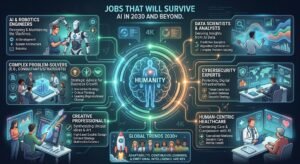
Jobs That Will Survive AI in 2030 and Beyond: Future-Proof Careers You Can Count On
Focus Keyword: Jobs That Will Survive AI in 2030 and Beyond
SEO Title: Jobs That Will Survive AI in 2030 and Beyond: 15 Future-Proof Careers
Meta Description: Discover the top jobs that will survive AI in 2030 and beyond. Learn why these careers remain valuable, the skills you’ll need, and answers to common questions about AI-proof jobs.
Why Some Jobs Will Survive AI
AI is excellent at processing data, recognizing patterns, and automating repetitive work. However, it still struggles with:
- Emotional intelligence
- Creativity
- Leadership
- Ethical decision-making
- Human relationships
- Complex real-world problem solving
These uniquely human abilities make certain careers much more resistant to automation.
Top Jobs That Will Survive AI in 2030 and Beyond
1. Healthcare Professionals
Doctors, surgeons, nurses, therapists, and psychologists require empathy, communication, and critical thinking that AI cannot fully replicate.
Why they’ll survive:
- Human trust
- Emotional support
- Personalized treatment
- Ethical medical decisions
2. AI Engineers and Machine Learning Specialists
Ironically, AI creates demand for professionals who build, improve, and manage AI systems.
Required skills
- Python
- Machine Learning
- Data Science
- Deep Learning
- Cloud Computing
3. Cybersecurity Experts
As cyber threats become more sophisticated, organizations need skilled professionals to protect digital systems.
Key responsibilities
- Threat detection
- Security audits
- Incident response
- Ethical hacking
4. Software Developers
Although AI can generate code, developers still design systems, solve complex problems, and build innovative applications.
Future skills
- System architecture
- Problem-solving
- Cloud development
- AI integration
5. Teachers and Educators
Education involves motivation, mentorship, and adapting lessons to individual students.
AI can assist teachers but cannot replace meaningful human interaction in learning.
6. Creative Professionals
Creative careers continue to thrive because originality remains a human strength.
Examples include:
- Writers
- Designers
- Filmmakers
- Musicians
- Brand strategists
7. Mental Health Professionals
Demand for therapists, counselors, and psychologists continues to grow worldwide.
People seek human understanding rather than automated conversations for emotional support.
8. Skilled Trades
Hands-on professions remain difficult to automate.
Examples:
- Electricians
- Plumbers
- Carpenters
- Mechanics
- HVAC technicians
These jobs require adaptability in changing physical environments.
9. Business Leaders and Entrepreneurs
Strategic thinking, innovation, negotiation, and leadership are difficult to automate.
Successful entrepreneurs combine:
- Vision
- Risk management
- Human relationships
- Market understanding
10. Human Resource Professionals
Recruitment involves evaluating culture fit, communication skills, and leadership potential.
AI can screen resumes, but final hiring decisions require human judgment.
11. Legal Professionals
Lawyers and legal consultants handle negotiations, courtroom advocacy, and ethical reasoning.
AI assists with research but cannot replace legal expertise entirely.
12. Scientists and Researchers
Scientific discovery requires curiosity, experimentation, and innovative thinking.
Researchers in biotechnology, renewable energy, and medicine are expected to remain highly valuable.
13. Digital Marketing Strategists
AI helps generate content, but marketing strategy requires understanding customer behavior, branding, and business goals.
Skills include:
- SEO
- Content Marketing
- Analytics
- Branding
- Customer Psychology
14. Project Managers
Managing people, budgets, deadlines, and stakeholders requires communication and leadership beyond automation.
15. Environmental and Renewable Energy Specialists
Climate change is creating demand for experts in sustainable technologies.
Examples:
- Solar engineers
- Wind energy specialists
- Environmental consultants
- Sustainability managers
Skills That Make You AI-Proof
To remain competitive after 2030, focus on developing these skills:
- Critical thinking
- Emotional intelligence
- Creativity
- Leadership
- Communication
- Problem-solving
- Adaptability
- Digital literacy
- AI collaboration
- Continuous learning
How to Prepare for an AI-Driven Future
Here are practical steps you can take:
- Learn AI tools relevant to your industry.
- Keep upgrading your technical skills.
- Build strong communication abilities.
- Focus on creative thinking.
- Earn certifications in high-demand fields.
- Network with industry professionals.
- Stay informed about emerging technologies.
Will AI Replace Every Job?
No.
History shows that technology changes jobs rather than eliminating work entirely. AI is expected to automate repetitive tasks while creating new roles in technology, healthcare, cybersecurity, sustainability, and digital services.
The future belongs to professionals who combine human skills with AI tools.
Conclusion
The jobs that will survive AI in 2030 and beyond are those centered on human creativity, emotional intelligence, strategic thinking, and hands-on expertise. Rather than fearing AI, professionals should learn to work alongside it.
By continuously improving your skills and embracing new technologies, you can build a career that remains valuable well beyond 2030.
Frequently Asked Questions (FAQs)
1. What jobs will survive AI in 2030?
Healthcare professionals, software developers, cybersecurity experts, teachers, skilled trades, AI engineers, project managers, and creative professionals are expected to remain in demand.
2. Which careers are most AI-proof?
Careers requiring emotional intelligence, creativity, leadership, and complex decision-making are considered the most AI-resistant.
3. Can AI replace software developers?
AI can automate parts of coding, but developers are still needed for system design, architecture, innovation, and solving complex business problems.
4. Is digital marketing safe from AI?
Yes, although AI assists with content creation and analytics, human marketers are essential for strategy, branding, customer engagement, and creative campaigns.
5. What skills should I learn to stay relevant after 2030?
Focus on critical thinking, communication, leadership, creativity, emotional intelligence, digital literacy, and learning how to use AI effectively.
6. Will AI create new jobs?
Yes. AI is expected to generate new opportunities in AI development, cybersecurity, robotics, data science, AI ethics, renewable energy, and advanced healthcare.
7. Which industries will grow because of AI?
Industries likely to expand include healthcare, cybersecurity, AI development, renewable energy, education technology, biotechnology, cloud computing, and digital marketing.
8. Is learning AI necessary for future careers?
Yes. Understanding how AI works and using AI tools can improve productivity and make you more competitive in almost every industry.