
SEO Basics for Beginners: A Simple Step-by-Step Guide
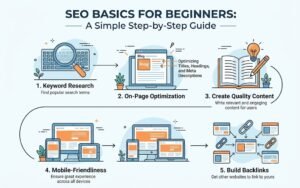
Want to rank higher on Google but don’t know where to start? SEO basics for beginners can feel confusing at first, but the truth is that a few simple steps can make a big difference. From choosing the right keywords to writing helpful content and optimizing your pages, SEO is easier to learn when you break it into small, practical parts.
What SEO Means
For anyone learning SEO basics for beginners, the first step is understanding what SEO actually is. SEO stands for Search Engine Optimization, which simply means improving your website so search engines like Google can understand it better and show it to the right people. If your content is useful but hard to find, SEO helps bridge that gap.
In simple words, SEO is about making your page easier to discover, easier to read, and easier to trust. When those three things improve, your chances of ranking increase too.
SEO is not a single trick or shortcut. It is a mix of small improvements that work together. Some of those improvements happen on the page itself, while others happen behind the scenes. When you combine them properly, your content has a much better chance of appearing in search results.
Why SEO matters
SEO matters because most people do not click past the first page of Google. If your content appears higher, it gets more visibility, more clicks, and more potential readers or customers.
Here’s why it is useful:
-
It brings free organic traffic.
-
It helps people find your content when they need it.
-
It builds trust over time.
-
It can support blog growth, leads, and sales.
-
It works long-term instead of disappearing after one post.
For beginners, this is important because SEO gives your content a fair chance to compete, even if your website is new.
How search engines work
Search engines try to do three main things:
-
Crawl pages on the web.
-
Understand what each page is about.
-
Decide which pages are most useful for a search query.
That means your job is to make your content clear enough for Google to understand. If your page is about “SEO basics for beginners,” then the topic, headings, wording, and structure should all support that idea.
Think of it like this: search engines are trying to match a question with the best answer. Your content should be that best answer.
The three main parts of SEO
SEO can be broken into three broad areas:
-
On-page SEO.
-
Off-page SEO.
-
Technical SEO.
On-page SEO is everything you do on the page itself, like titles, headings, and content quality. Off-page SEO is about signals from outside your website, such as backlinks and mentions. Technical SEO covers the site’s structure, speed, mobile usability, and crawlability.
You do not need to master everything at once. A beginner should start with the basics:
-
Choose a clear topic.
-
Use a relevant keyword.
-
Write helpful content.
-
Structure it well.
-
Make the page easy to use.
What beginners should focus on first
If you are new, the fastest way to improve SEO is to focus on the fundamentals. You do not need advanced tactics before you understand the basics.
Start with:
-
One main keyword.
-
One clear topic.
-
One useful page.
-
One audience problem.
-
One strong answer.
This keeps the content focused. A focused page is easier for search engines to categorize and easier for readers to trust.
For example, instead of writing a vague article about “marketing,” write something specific like “SEO basics for beginners” or “how to improve blog SEO.” Specific topics usually have clearer search intent and are easier to optimize.
Practical example
Let’s say you have a blog post called “SEO Basics for Beginners.”
A weak version of the post might:
-
Jump between unrelated topics.
-
Use no clear headings.
-
Repeat the same point multiple times.
-
Fail to explain what SEO means.
A stronger version would:
-
Define SEO in the first section.
-
Explain why it matters.
-
Show how search engines work.
-
Break down the main parts of SEO.
-
End with a simple beginner plan.
The second version performs better because it is easier to read, easier to understand, and easier for Google to interpret.
Common beginner mistake
One common mistake is trying to rank for too many ideas in one article. A beginner may write about keywords, backlinks, page speed, social media, content writing, and analytics all in the same post without clear structure.
That can make the article confusing.
A better approach is to keep one page focused on one main idea. Then create separate articles for related topics later. This helps you build topical authority gradually.
Simple takeaways
If you remember nothing else, remember this:
-
SEO helps people find your content.
-
Clear pages rank better than confusing ones.
-
Beginners should start with one keyword and one topic.
-
Good structure matters as much as good writing.
Once you understand what SEO means, the rest becomes much easier. It gives you the foundation you need before moving into keyword research, content optimization, and link building.
FAQs
1. What is SEO and why is it important for beginners?
SEO (Search Engine Optimization) is the practice of optimizing your website so search engines like Google can understand your content and show it to relevant users. For beginners, SEO is essential because it drives organic (free) traffic to your blog, helps build authority in your niche, and delivers long-term results without relying solely on paid advertisements.
2. How do I choose the right keyword for a beginner blog post?
To choose the right keyword, start with a specific topic your target audience is searching for and focus on low-competition, long-tail keywords (phrases containing 3–5 words). Make sure the keyword has clear search intent—meaning the searcher’s query directly aligns with the solution or information your post provides.
3. What is the difference between On-Page, Off-Page, and Technical SEO?
-
On-Page SEO refers to optimizing content on your page, such as titles, headings, image alt text, and main text.
-
Off-Page SEO involves actions taken outside your website to build trust, mainly through acquiring backlinks and social mentions.
-
Technical SEO ensures search engine spiders can crawl and index your site easily by optimizing site speed, mobile responsiveness, and page structure.
4. How long does it take for SEO to show results on Google?
SEO is a long-term strategy. For a new blog or website, it typically takes anywhere from 3 to 6 months to start seeing noticeable ranking improvements and traffic growth. Search engines need time to crawl, index, evaluate content quality, and build trust in your site domain.
5. What are the most important SEO factors to focus on first?
Beginners should focus on three primary fundamentals first:
-
Writing high-quality, helpful content that satisfies user intent.
-
Properly organizing pages using clear heading tags (<h1>, <h2>, <h3>) and descriptive title tags.
-
Ensuring the website loads fast and works seamlessly on mobile devices.