
How to Optimize Your Content for AI Search
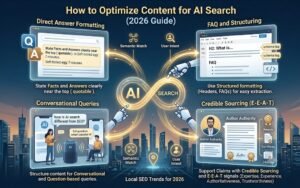
Would your content survive if Google search disappeared tomorrow? That’s not as far-fetched as it sounds. Millions of people now ask ChatGPT, Perplexity, and Google’s AI Overviews their questions instead of typing keywords into a search bar — and most websites are completely invisible to them. This is exactly why AI search optimization has become the most urgent skill in content marketing right now. The old rules of ranking on page one still matter, but they’re no longer enough. AI engines don’t just crawl your page — they read it, judge it, and decide whether it’s worth quoting back to the person who asked. Get it right, and your content gets cited by the very tools shaping how people find information. Get it wrong, and you become invisible in the search results that matter most. Here’s exactly how to fix that.
What Is AI Search Optimization (And How Is It Different From SEO)?
Traditional SEO was built around one goal: getting your page to rank on Google’s results page. You optimized for keywords, backlinks, and page speed, and success meant a blue link in the top ten.
AI search optimization works differently. Instead of just ranking a page, you’re optimizing for whether an AI engine — ChatGPT, Perplexity, or Google’s AI Overviews — chooses to read, understand, and cite your content when answering someone’s question directly.
The differences matter more than they first appear:
- Traditional SEO rewards keyword placement and backlink volume.
- AI search optimization rewards clear, direct answers that AI models can easily extract and quote.
- Traditional SEO sends the reader to your website.
- AI search optimization often answers the question for the reader, inside the AI tool itself — meaning your brand needs to earn the citation, not just the click.
This is where AI Overviews SEO becomes its own discipline. Google’s AI Overviews pull short, specific answers from pages that state facts clearly near the top of the content, rather than burying them under long introductions.
Example: A recipe blog ranking #3 on Google for “how long to boil an egg” might still lose the AI Overview citation to a competitor ranked #7 — simply because that competitor states “7 minutes for a soft-boiled egg” in one direct sentence near the top of the page, while the #3 result buries the answer inside a long story about grandma’s kitchen.
SEO Meta Title
How to Optimize Content for AI Search: 2026 Guide
Meta Description
AI is changing how people search. Learn proven AI search optimization tactics to get your content cited by ChatGPT & AI Overviews. Read now.
Image Alt Text Suggestions:
Diagram comparing traditional SEO ranking factors vs AI search optimization signalsExample of content formatted with a direct answer block for AI Overviews SEOScreenshot showing AI chatbot citing a website source in a conversational search result
Internal Link Anchor Texts:
how AI Overviews SEO differs from traditional ranking factorsstructuring content for conversational and question-based queriesbuilding E-E-A-T signals AI search engines trusttools to track your AI search visibility7 practical tactics to improve AI search rankings
FAQ Content
1. What is AI search optimization?
AI search optimization is the practice of structuring content so AI-powered tools — like ChatGPT, Perplexity, and Google’s AI Overviews — can easily read, understand, and cite it when generating answers to a user’s question. Unlike traditional SEO, which focuses on ranking a page in a list of results, AI search optimization focuses on earning a citation inside the AI-generated answer itself.
2. How is AI search optimization different from traditional SEO?
Traditional SEO rewards keyword placement, backlinks, and page speed to rank a page higher in search results. AI search optimization rewards clear, direct, well-structured answers that AI models can extract and quote. Both still depend on strong technical fundamentals and credible content, but AI search optimization adds a second requirement: your content must be “quotable,” not just “rankable.”
3. What is Google AI Overviews SEO?
AI Overviews SEO refers to optimizing content specifically so it gets selected and cited within Google’s AI Overviews feature. This means stating clear facts and direct answers near the top of the page, using structured formatting like headers and FAQs, and supporting claims with credible sourcing — since AI Overviews tend to pull from pages that state information plainly rather than burying it in long introductions.
4. Do I need to abandon traditional SEO to optimize for AI search?
No. Traditional SEO remains the foundation — technical health, site structure, and E-E-A-T signals still matter for both classic rankings and AI citations. AI search optimization builds on top of solid SEO rather than replacing it, adding extra emphasis on clear answer formatting, FAQ sections, and content structured for direct extraction.
5. How can I track whether my content is being cited by AI search tools?
You can monitor AI search visibility through tools like Google Search Console, which reports on visibility from Google’s generative AI features, including AI Overviews and AI Mode. Beyond Search Console, some businesses manually test their target queries across ChatGPT, Perplexity, and Google to see whether their brand or content appears in the generated answer.