
If this stat doesn’t make you nervous, I don’t know what will: close to 50% of Google searches have local intent – your next customer is probably searching for businesses “near me” right now, and they are not searching for your brand name. If you aren’t appearing, your competition will be.
This is where professional local SEO services for small businesses come into play. Unlike large, national SEO campaigns, the focus of local SEO is to attract the right customers from your geographical location at the precise point of decision. This might be a query like “emergency plumber near me” or “coffee shop near the main library.”
In this comprehensive 2026 guide to local SEO services, you will understand exactly what the services entail, the costs involved with them, whether doing local SEO services yourself is a better choice than outsourcing to an agency, and the factors to consider when hiring a provider. We are going to make sure that your business is discovered!
What are Local SEO Services?
If you’ve searched anything like “coffee shop near me” or “emergency plumber [your city],” you’ve just performed the type of search that local SEO services are designed to conquer.
Fundamentally, local search engine optimisation refers to the process of increasing your business’s prominence in location-based searches – things like the map listings, the “near me” queries, and the geo-specific organic rankings that show up for any search that indicates the user is interested in a local provider. It is an offshoot of SEO that is more practical, and often much more profitable, than attempting to achieve top rankings for highly competitive, national keywords.
Let’s look more closely.
Local vs. Traditional SEO: What’s the Distinction?
Traditional or national SEO is concerned with optimising a web page to achieve a ranking in a search engine results page (SERP) regardless of the searcher’s location. For instance, when a SaaS business optimises for the keyword “project management software,” its objective is to rank regardless of whether the searcher is based in Denver or Dublin.
Local SEO, on the other hand, puts relevance in a specific location first. A few crucial differences include:
– Search Intent is Geographic. Queries like “near me,” “in [city],” and those that carry implied local intent (Google is getting much better at inferring this) determine the results.
– Google Business Profile is King. While traditional SEO never addresses the Google Business Profile, for local SEO, it is arguably the most important ranking factor you’ll have to deal with.
– The Map Pack Competes Heavily with or Rivals Organic Listings. The result with three nearby locations with ratings, hours, and a telephone number is often the first information the user seeks, and traditional SEO is a distant third in terms of influencing it.
– The Weight of Citations and Local Directory Listings. Your company’s name, address, and phone number (NAP), listed consistently across the web, is a local-specific signal that simply does not exist with traditional SEO.
In essence: Local SEO is for the business that depends on customers visiting its location, calls coming from a local number, or services provided within a localised geographic area.
Why Local SEO is Essential for Businesses in 2026
Local search behavior has only grown, which is exactly why local SEO services for small business owners have become less of a luxury and more of a necessity. Here are some truths that small business owners are already facing in 2026:
– Mobile “Near Me” Searches Remain on Top. Today, nearly all local searches are mobile; those performed are for businesses to visit immediately.
– Zero-Click Searches are Proliferating. A surprisingly large percentage of local searches are now answered solely on the SERP thanks to the GMB and the map pack; customers need your information now and will not have to click to visit a website to find it. If your GMB isn’t optimized, you may be losing business even though you’re being found.
– Voice and AI Searches Leverage Local Data. Searches like “who is open near me right now” from a smart device have many similar ranking signals to local search (proximity, reviews, hours and services), and the way this information is structured is vital.
– More Small Businesses Are Competing. Many companies are now actively involved in their local SEO efforts, meaning that if you’re not, you’re losing ground to those who are.
For small businesses with limited resources, local SEO offers a way to compete with much larger firms on a more level playing field – its core algorithms heavily weight the searcher’s location, as well as their relevance, but not domain authority in the way traditional SEO does.
How Google Prioritises Local Results
Google has been fairly transparent that the algorithm for determining the best local SEO results consists of three primary factors:
1. Relevance
The degree to which your website and business profile accurately represents what the searcher is looking for. A bakery promoting “birthday cakes” will always rank higher for that keyword than one specialising in “cupcakes.”
2. Distance
The proximity of your business to the searcher’s location or the location specified in the search. For this reason, an identical search performed in two different locations may produce totally different results.
3. Prominence
This is primarily influenced by how well-known and respected your business is, determined by a number of metrics like links, reviews (quality and volume), mentions, and brand citations across the web. This can happen regardless of whether a backlink is present.
Ultimately, while you cannot control a customer’s distance from your business, you can control a great deal about proximity and prominence- which is exactly what local SEO services aim to achieve.
An Everyday Scenario
Consider “Riverside Plumbing Co.” versus “Anytown Plumbers.”
Riverside Plumbing boasts a fantastic website but lists the wrong address in its Google Business Profile, refers to itself as three different entities across the web (Riverside Plumbing Co, Riverside Plumbing, Riverside Plumbing Company LLC), and possesses a mere 4 reviews.
Anytown Plumbers, though it has only an ordinary website, has a fully optimised Google Business Profile listed under the precise category of “Emergency Plumber.” It includes recent service areas, hours of operation, and has received 87 4.8-star reviews, with responsive answers from the owner included.
When an “emergency plumber near me” search is initiated at 11 PM on a Tuesday, Anytown Plumbers nearly always beats Riverside Plumbing in map search results. Why? Riverside’s local SEO foundation (consistent branding, correct NAP information) and relevance (Category, GMB profile filled out) are greatly inferior.
Local SEO services for small business owners exist precisely to improve and close such gaps.
What Are Local SEO Services Generally Made Of?
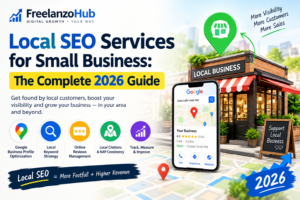
When you engage an agency or manage it yourself, there are a handful of broad categories that Local SEO efforts tend to fall under:
– Google Business Profile Setup and Optimisation. Categories, services, images, posts, and questions are all addressed.
– Citation and NAP Management. Consistently displaying your Name, Address, and Phone Number (NAP) across various online directories like Yelp, Apple Maps, industry-specific directories, etc.
– Reviews Management. Developing systems for requesting and responding to customer reviews.
– On-page Local Optimisation. Optimising service location pages, using local schema markup, and integrating geo-specific content on your website.
– Local Link Building. Earn links from local businesses, press or any organisation within your town.
These are not mutually exclusive tasks, but a combination of factors that together communicate to search engines that you are a legitimate and relevant business within a specified geographic area. More detail on each below.
Main Takeaways
– Local SEO is about reaching customers who are actively looking for local products or services; it’s a localised form of SEO.
– The GMB, local citations and reviews play a major role, which isn’t even addressed in traditional SEO.
– Since nearly all of those searches are initiated on a phone, in 2026 local SEO is more important than ever before.
-Investing in local SEO services for small business growth gives you the chance to appear and rank higher than larger firms, simply because relevance, not domain authority or number of links on traditional SEO, comes into play and you have control over many factors involved.
First, though, we should dive deeper into each individual task that encompasses a comprehensive local SEO service, beginning with the most critically important task: optimisation of the Google Business Profile.
FAQ Section
Q1: How Much Should I Spend on Local SEO for My Small Business?
Small businesses can expect to pay $300 to $2,000+ per month for localised SEO services-or quite a bit less than that for just GBP. Single-location businesses in low-competition industries-like small-town bakeries-can still expect great results by staying within $300 to $800 per month. A multi-location business (or one-off location) in a high-competition urban area, like a city where you find lots of dentists, lawyers, or home services, should expect to invest $1,500 or more a month to compete truly. An individual-instance, one-time local GBP setup and citation clean-up usually costs between $300 and $1,000.
Q2: Why Isn’t My Business Showing Up on Google Maps?
Top reasons in order of most probable to least: 1) your GBP is not verified/ incomplete 2) inconsistent NAP information in directories 3) you don’t have as many/any reviews as your competitors 4) your business category doesn’t match what people are searching for exactly 5) you are simply too far away from the searcher relative to other competitors. The first thing you should do is review your GBP for missing information and check NAP consistency across major directories.
Q3: How Long Does It Take to See Results from Local SEO?
Typically 3–6 months for noticeable movement, and 6–12 months for strong, stable rankings. Some wins come faster — GBP optimisation and citation fixes can show impact in 2–4 weeks — but review growth, content authority, and local link building compound over time. Local SEO services for small business owners are not a one-time fix; businesses that stop investing after initial gains often see rankings slip back within a few months.
Q4: I already have a Google Business Profile, should I still have a website?
Yes. With only a GBP, you are restricted to the Google ecosystem and only associated fields. A website will allow you to rank for more terms, allow you to create location-based pages for businesses in multiple locations, build authority and let you have far more control over your customers’ experience, unlike on the limited Google Business Profile.
Q5: What is the difference between Local SEO and paid local ads such as Google Local Service Ads?
Local SEO is where organic, compounded presence within local and organic search results; this continues to work over time and has nothing to do with how much money you continue to spend on ads. Local service ads and Google Ads instantly have a top presence; however, the visibility will only be there for as long as you continue to pay for the ad.