
Performance Marketing for Beginners: Complete Guide (2026)
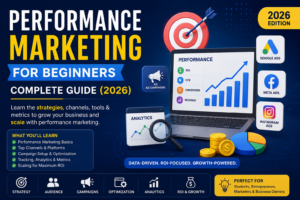
What if you only had to pay for marketing that actually worked — no wasted spend, no guessing games? That’s the entire premise behind one of the fastest-growing approaches in advertising today.
Businesses worldwide are shifting billions of dollars away from traditional, brand-awareness advertising and into strategies where every rupee spent is tied to a measurable result — a click, a lead, a sale. This is performance marketing for beginners in its simplest form: marketing that pays for outcomes, not impressions.
If you’re new to digital marketing and wondering how platforms like Google Ads, Meta Ads, and affiliate programs actually generate real business results, you’re in the right place. In this guide, we’ll break down exactly what performance marketing is, the channels and metrics that matter, and a step-by-step roadmap to launch your very first campaign — even with zero prior experience.
What Is Performance Marketing?
If you’ve spent any time researching digital advertising, you’ve probably run into the term “performance marketing” used almost interchangeably with “digital marketing.” They sound similar. They often overlap. But they are not the same thing — and understanding the difference is one of the most important first steps for anyone starting out in this field.
This section breaks down exactly what performance marketing is, how it actually works at a practical level, and where it fits (or doesn’t fit) within the broader world of digital marketing.
A Simple Definition
At its core, performance marketing is a form of advertising where you only pay when a specific, measurable action happens.
That action could be:
- A click on your ad
- A form submission or lead
- A completed sale
- An app install
- A sign-up for a newsletter
Unlike traditional advertising — where a business pays a fixed amount upfront regardless of results (think: a billboard, a TV commercial, or a magazine ad) — performance marketing ties the cost directly to a specific, trackable outcome. If the outcome doesn’t happen, in many models, you don’t pay.
This is why performance marketing is often described as “pay-for-results” advertising. It shifts the financial risk away from the advertiser and places accountability on actual, measurable performance.
A Helpful Way to Think About It
Imagine you’re paying a salesperson. There are two ways to structure their pay:
- Flat salary — they get paid the same amount whether they close 2 deals or 20. This is closer to traditional/brand marketing.
- Commission-based — they only get paid when they actually close a sale. This is the essence of performance marketing.
Most businesses today want the second model for at least part of their marketing budget, because it directly ties spending to results.
Performance Marketing vs Digital Marketing: What’s the Difference?
This is where a lot of beginners get confused, so let’s clear it up directly.
Digital marketing is the umbrella term for any marketing activity that happens through digital channels — websites, social media, email, search engines, apps, and more. It includes things like:
- SEO (search engine optimization)
- Content marketing (blogs, videos, podcasts)
- Email marketing
- Social media marketing (organic posts, community building)
- Paid advertising (Google Ads, Meta Ads)
- Performance marketing
Performance marketing, on the other hand, is a specific subset of digital marketing. It’s not a separate universe — it lives inside digital marketing, but with one defining trait: every dollar (or rupee) spent is tied to a measurable, trackable action.
Here’s a side-by-side breakdown to make the performance marketing vs digital marketing distinction crystal clear:
| Aspect | Digital Marketing (Broad) | Performance Marketing (Subset) |
|---|---|---|
| Scope | Includes all online marketing activities | Focuses only on pay-for-results campaigns |
| Payment model | Can be flat fee, subscription, or free (organic) | Pay per click, lead, sale, or install |
| Goal | Can include brand awareness, engagement, education | Almost always tied to a measurable conversion |
| Measurability | Sometimes hard to measure directly (e.g., brand awareness campaigns) | Highly measurable — tracked to the individual action |
| Examples | SEO, content marketing, email newsletters, organic social | Google Ads (PPC), Meta Ads, affiliate marketing, influencer performance deals |
So when someone asks “is performance marketing the same as digital marketing?” — the accurate answer is: performance marketing is a type of digital marketing, but not all digital marketing is performance marketing.
A blog post you write for SEO purposes is digital marketing — but it isn’t performance marketing, because you’re not paying per click or per result for that blog post to exist. On the other hand, a Google Ads campaign where you pay every time someone clicks your ad is performance marketing, because your cost is directly tied to a measurable action.
Why This Distinction Matters for Beginners
Understanding performance marketing vs digital marketing isn’t just an academic exercise — it directly affects how you should think about budgeting, strategy, and expectations as a beginner.
- If you’re doing digital marketing broadly (like SEO or organic social media), results often take months to show up, and you’re investing in long-term brand equity.
- If you’re doing performance marketing specifically, you can often see results — clicks, leads, sales — within days or even hours of launching a campaign, because everything is tracked and measured in near real-time.
This is one of the biggest appeals of performance marketing for beginners: the feedback loop is fast. You don’t have to wait six months to know if something is working.
The Core Principle Behind Performance Marketing
Everything in performance marketing comes back to one core principle: accountability through measurement.
This principle shows up in a few key ways:
- Every campaign has a trackable goal — whether that’s a sale, a lead, or a click, there’s always a specific, measurable outcome the campaign is designed around.
- Data drives every decision — instead of guessing what’s working, performance marketers look at real numbers (clicks, conversions, cost per result) to decide what to keep running and what to shut off.
- Budgets are flexible and responsive — because you can see results almost immediately, you can adjust spend in real time, putting more money behind what’s working and pulling back from what isn’t.
This is fundamentally different from traditional brand marketing, where a company might run a TV ad campaign for months without being able to directly measure how many sales it generated. Performance marketing removes much of that guesswork.
A Practical Example: How Performance Marketing Actually Works
Let’s walk through a real-world style example to make this concrete.
Imagine a small business — say, an online store that sells handmade skincare products. The owner wants to grow sales and decides to run a performance marketing campaign using Google Ads.
Here’s what that looks like in practice:
Step 1: Define the goal The owner decides the goal is simple — get people to buy a specific product, a face serum, from the website.
Step 2: Set up the campaign Using Google Ads, the owner creates an ad that appears when people search for terms like “natural face serum” or “organic skincare for dry skin.” Critically, the owner only pays Google when someone actually clicks on the ad — not just when it’s shown (this is the CPC, or cost-per-click, model).
Step 3: Track the results Using a tool like Google Analytics, the owner tracks how many people who clicked the ad actually went on to purchase the serum. Let’s say:
- 1,000 people saw the ad (impressions)
- 50 people clicked on it (clicks)
- 5 people bought the product (conversions)
Step 4: Calculate performance From this data, the owner can calculate exactly how much it cost to generate each sale (cost per acquisition, or CPA) and how much revenue that sale generated (return on ad spend, or ROAS). If the numbers work — meaning the sale value is higher than what was spent to get it — the owner scales up the budget. If not, the ad is adjusted or paused.
Step 5: Optimize and repeat Maybe the owner realizes that ads targeting “organic skincare for dry skin” converted much better than the broader “natural face serum” term. So the budget shifts more heavily toward that specific, better-performing keyword.
This entire process — pay only for clicks, track every action down to the sale, and continuously adjust based on real data — is performance marketing in action. Contrast this with a scenario where the same business instead placed a print ad in a local newspaper. The business would pay a flat fee regardless of how many people actually saw the ad or made a purchase because of it, with almost no way to directly measure the return. That’s traditional marketing — and it’s a world apart from the trackable, accountable nature of performance marketing.
Where Performance Marketing Fits in a Business’s Overall Strategy
It’s worth noting that performance marketing usually works best as part of a broader marketing strategy, not as a complete replacement for everything else.
- Brand marketing (traditional ads, sponsorships, PR) builds long-term recognition and trust — even if it’s hard to directly measure ROI.
- Organic digital marketing (SEO, content, social media) builds sustainable, long-term traffic without ongoing ad spend, but takes time to show results.
- Performance marketing delivers fast, measurable results and is excellent for driving immediate sales, leads, or growth — but often requires continuous spend to sustain results (once you stop paying for ads, the traffic generally stops too).
Smart businesses — and smart beginners — usually blend all three. Performance marketing tends to be the fastest way to start seeing tangible results, which is exactly why it’s such a popular entry point for people getting into marketing, whether as a career or as a business owner trying to grow.
Key Takeaways: What Is Performance Marketing?
Before moving to the next section, here’s a quick recap of the essentials:
- Performance marketing is a form of advertising where you only pay for measurable, specific actions — clicks, leads, sales, or installs.
- It is a subset of digital marketing, not a separate category — this is the key to understanding performance marketing vs digital marketing correctly.
- The core principle is accountability through measurement: every campaign has a trackable goal, and data drives every decision.
- Unlike traditional marketing, performance marketing offers a fast feedback loop — you can often see results within days, not months.
- It works best as part of a broader strategy that also includes brand building and organic digital marketing efforts.
In the next section, we’ll dig deeper into exactly how performance marketing works behind the scenes — including the different pricing models (CPC, CPA, CPL, CPM), the role of tracking and attribution, and who the key players are in a performance marketing campaign.
FAQ Section:
1. Is Digital Marketing Worth Learning if I’m Starting from Zero?
Yes — and the “zero” starting point matters less than people think. Digital marketing is one of the more accessible skill areas to break into because:
- Most core skills (SEO basics, running ads, social media management, email marketing) can be learned through free or low-cost resources like Google’s own certifications, YouTube, and hands-on practice.
- You don’t need a specific degree — many successful digital marketers come from completely unrelated backgrounds (commerce, engineering, arts, even homemakers returning to work).
- The field rewards practical skills over credentials. A well-run sample campaign or a small portfolio often carries more weight with employers than a certificate alone.
That said, it’s worth being honest about the trade-off: because it’s accessible, competition has increased significantly in recent years. Starting from zero is absolutely workable, but expect the first 3–6 months to be about building genuine skill (not just watching tutorials) before you start seeing real opportunities.
2. How Long Does It Take to Get Your First Digital Marketing Job?
This varies quite a bit based on effort and approach, but a realistic range for most beginners is 3 to 8 months from starting to learn to landing a first paid role or client.
Here’s what typically influences that timeline:
- Focused learning (1–2 months): Picking one or two specializations (e.g., SEO + Google Ads, or Social Media + Content) rather than trying to learn everything at once speeds things up considerably.
- Building a portfolio (1–2 months): Running a few sample campaigns — even for a friend’s small business or your own personal blog/Instagram — gives you something concrete to show, which matters more than certificates alone.
- Applying and networking (1–3 months): Direct outreach to small businesses, agencies, and freelance platforms often moves faster than waiting on traditional job applications.
A realistic expectation-setter: very few people land a job in “2 weeks,” despite what some course ads promise. Most who get hired quickly already had some overlapping skill (writing, sales, basic tech comfort) that shortened their learning curve.
3. Can You Make Good Money in Digital Marketing from a Tier 2 City?
Yes — and this is genuinely one of the biggest advantages of digital marketing as a career path in India right now.
- Remote-first nature of the work means your income isn’t capped by local job markets the way many traditional careers are. A skilled digital marketer in a Tier 2 city can work for clients or companies based in Delhi, Mumbai, Bangalore, or even internationally.
- Freelancing evens the playing field — platforms like Upwork and Fiverr, along with direct outreach to businesses, don’t care where you’re located; they care about results.
- Lower cost of living is an advantage, not a limitation — the same ₹30,000–₹50,000/month income goes further in a Tier 2 city than in a metro, making early-career digital marketing income feel more substantial.
That said, a few honest caveats:
- Full-time agency or corporate jobs are still more concentrated in metro cities, so if you want a traditional office job specifically, options may be more limited locally.
- Building initial trust with clients often takes a bit longer without a “big city” resume line, so a strong portfolio matters even more.
4. What is the difference between performance marketing and digital marketing?
Digital marketing is a broad umbrella term for any marketing activity carried out through digital channels, including SEO, content marketing, email, and social media. Performance marketing is a specific subset of digital marketing where advertisers only pay for measurable actions — such as a click, lead, or sale — rather than paying a flat fee regardless of results. In short, all performance marketing is digital marketing, but not all digital marketing is performance marketing.
5. Which channel is best for beginners in performance marketing?
Google Ads (paid search) and Meta Ads (paid social) are generally the best starting points for beginners because they offer detailed targeting options, real-time performance data, and relatively low minimum budgets. Google Ads works well for capturing people actively searching for a product or service, while Meta Ads is effective for reaching people based on interests and demographics, even if they aren’t actively searching yet.